Coconut Oil For Skincare

SPE-11201-1

I have received numerous questions and concerns regarding coconut oil for skincare. I think it is a great option for most skin types. Sensitive skin may not be able to tolerate the acidity while some may be able to because of its immediate pure hydration factor that acts as a buffer for the skin and the acidity content. Too much acid may thin and further sensitize the skin. Since all skin types are different, I recommend giving it a simple try and seeing if your skin likes it and can tolerate it. Coconut oil has many uses in any given week for my skincare routine. And I will share those uses with you.

If you want younger looking skin, it needs to appear soft. If your skin is dry, impacted (dried out with enlarged pores), hardened and tough looking, this is the opposite of soft looking. I will immediately recommend trying a more natural hydration approach to your skincare routine if you are not already applying natural ingredients.

Proper hydration followed by proper exfoliation for your skin type will eventually get your skin to appear softer. Please remember typical exfoliation to the masses is considered scrubbing. I recommend enzymes for all skin types instead. This consists of a digestion process followed by sedation to let the skin rest and begin new cellular regeneration, or turnover. As opposed to continued stimulation for those built up skin cells by a vigorous scrubbing motion.

Proper hydration can begin with one or two ingredients. Let’s start with the coconut craze. So many questions have come up about coconut oil. My recommendation is to buy it and see if you like it. I like the results it offers very much and so do several of my clients. I do not care for the buttery smell lingering for 45 minutes on my face but I do like the hydrating effects it offers. Here is one application technique. Once applied I will take a cool, wet damp wash cloth and pat my face. I then allow it to hang out. It takes several minutes to dry but gives a nice hydrated appearance. It takes away some of the scent and greasiness if it is patted down but still leaves an emollient layer on the surface of the skin.

I do find that other natural oils such as grape seed and sunflower seed oil seem to hide fine lines caused by dehydration a bit longer than coconut oil. But I still consider this a great hydrator choice and easy to incorporate into a regimen for most skin types.

Most coconut oils are loaded with 30-60% Vitamin C. This is fantastic for skin brightening and potential collagen reformation. We can all use more collagen rebuilding because it naturally depletes within our bodies beginning for most of us, within our 30’s and possibly earlier. Not only does collagen help keep fine lines and deep wrinkles away, it comprises our skin’s foundation and we only get one of those. Why not take care of it the best we can? I consider natural hydrator ingredients to be a wonderful choice and I do recommend coconut oil to be included in a skincare regimen if someone is interested in trying it out.

Extremely sensitized skin and reddened skin may become more sensitized from the acidity of the product. Since it is impossible for one ingredient to work miracles for every person’s skin, give it a try and see if you like it. Perhaps try it on a night you have no big event in the instance your skin does not favor it.

Potential uses that have worked for my skin, my face particularly:

Cleanser (then remove)

Leave on Cleanser (do not remove and it cleanses and hydrates)

Hydrator (my term for moisturizer, since I do not use ingredients that the commercialized skincare industry uses in to make my products)

Lip balm –

Eye makeup remover

If your product is gritty, especially unrefined products, simply rub in your fingertips prior to applying to your skin. Or keep blending into the skin and it should eventually melt and absorb into the skin.

If you have tried or continually use coconut oil in your skincare routine, please comment on your experience here! I give it two thumbs up and recommend it for most skin types.

The Emotional Side of Acne and Skin Imbalance (1 of 2)

Our mind and body are intimately interwoven, so much that there are commonly coined phrases such as the ‘mind-body connection’.  We’ve all heard that stress causes acne but did we ever stop to analyze the bodily mechanisms responsible for said skin imbalance?  We have been led for generations to believe the answer lies outside of ourselves.  If you experienced acne therapy in the 50’s it most likely consisted of UV radiation therapy as the theory went this type of therapy ‘cleared everything up’ similar to the process of the sun drying out blemishes.  Today, protocols and recommendations haven’t changed much for the typical acne sufferer visiting the dermatology office.  Some docs don’t even hear you out, you are observed and examined and given a prescription sheet with one to four prescriptions on it. Their best guess for the day.  Can you or anyone you know relate to this?  I’ve witnessed hundreds of teens and twenty-somethings  (and older) who are back for their umpteenth visit as the doctor’s response is ‘Well, let’s try this now and if 4-5 prescription acne meds fail then our ultimate option is Accutane”.  Additionally, if the office is a medical spa component you will be recommended for doctor grade products and medical grade acne treatments consisting of light therapy, laser, microdermabrasion, chemical peels and facials.  These treatments can offer much improvement if the proper steps, ingredients, and sequence is applied.  The issue for the average client is that despite what they have been led to believe with fancy brochures and attractive treatment series recommendations, the technician (dr, nurse, medical assistant, esthetician, etc) does not know what the outcome will be for your skin.  Simply painting that picture was stressful to contemplate!

The doctors must recommend prescriptions so the pharmaceutical companies continue to get rich while the unassuming patient comes back for the next attempt to clear the skin, yet a temporary relief or failed attempt is offered again.  Is this an attempt to mask symptoms or reveal the source of the imbalance?  While research studies and scientific journals have been offering conflicting views since the late 1800’s depicting diet,  originally known as medical nutrition therapy when guided by a doctor or registered dietician, as a possible culprit for acne flare-ups, the only solid studies that seem to hold water among top researchers are diets categorized as being high-glycemic.  It seems there has always been a hidden link between what we ingest and the presence of acne although I have numerously witnessed dermatologists in the treatment room stating the exact opposite to young teenagers and baby boomers alike, easily swayed by their doctor’s words.  Not once have a observed what I like to call a ‘real’ conversation getting to the heart of the matter.

Take a step back for me (and for you).  If I described a visual of your prior dermatology visits, then imagine you are an observer looking in this time.  And observe again through a new perspective, a new awareness.  What if the doctor had asked you, “Is there any emotional stress going on in your life currently or from your past”?  What would your answer have been?  I would’ve turned my appointment into a clinical psychological evaluation without trying very hard!  I come from an unhealthy childhood that resulted in much emotional pain in my teenage and early adulthood.  Little did I know that it had been trapped in my body for over two decades!  So what would your answer have been or what would it be?  Do you have to answer your hypothetical doctor?  You can save a copay and perhaps hundreds of dollars in prescriptions!  Can you simply answer to yourself?  None of us will have the same current or past story, but there is a common thread linking all, rather most of us acne (and other common skin condition) sufferers together:

Emotional Stress.

Several negative things occur in the body as a result of our everyday stressors that we simply deal with and manage day to day.  Recall from my previous articles how it is a given that the body is a self-‘detoxing’ machine and how it must maintain a homeostasis, a balance within itself in order to obtain a state of proper health.  When we are ‘stressed’ we instantly feel ‘anxious, annoyed, angry, upset, irritated, etc.  These negative emotions trigger several hormone responses in our body that lead to a myriad of…changes.  After all, emotional stress causes heart attacks.  Think upon the functions and mechanisms of the body that must all occur for a heart attack to be the end result of a little stress.  That little stress isn’t so trivial anymore, is it?

Scientifically speaking – when our body is in stress mode, also called survival mode, the blood and nutrients begin rushing toward the most vital organs to maintain appropriate levels to keep everything pumping and flowing smoothly.  The skin is the last organ to be nourished by nature but now the body neglects it even more so.  That is why if we are sick or tired we actually look haggard.  We all know or know of somebody who is very sick and undergoing treatment.  How does their skin look?  How do they look?  How would you describe it?  The body’s main focus is to keep those organs in proper functioning health (as much as possible).  And it does double duty in survival mode.  On top of the lessened nutrient delivery service to the skin, the hormones testosterone and androgen are released at a higher rate that increase oil production which surges through our pores causing an imbalance

It’s all around us and sometimes it is us, the stressed-out individual.  They are everywhere!  I used to be one of them.  Just being in the presence can dramatically alter your own stress levels instantly.  Until we become fully aware and in control of our emotions (not a simple task but it is worth the undertaking) we and our skin eruptions will be at the mercy of the world’s stressors.   I recently saw a weight-loss commercial with a digital body expanding and widening, getting fatter as Cortisol, a stress hormone is released.  I cannot recall the exact pill, I’m certain there are several that promise something similar to “with this pill, you can ….lose weight, feel and look better, look more attractive to the opposite sex..”  There’s a magic prescription, pill and program for everything.  Weight loss was never my issue, give or take a few pounds, or inch here or there.  However, depression and emotional pain was.  It took several (ten plus) years for me to realize all of that emotional pain was eating me alive.  Its physical manifestation for me presented itself in: cystic acne (what I thought of as incurable as I had tried everything and anything for it) and stomach upset.  The external answers are all around us promising instant results and relief!  But these are deceptive.  They are a lie, a mere distraction that keep us from discovering the truth.  The truth is that we must additionally look inside ourselves in order to be truly and fully healed of our imbalances.  Isn’t that how we are ultimately designed?   It’s not to live and think the way marketing agencies and global sales companies convince us that we are in desperate need of their ‘outside product’ to fix our physical representation (of internal imbalance presenting itself on our skin) for the world to see.  But if the world sees it and we feel uncomfortable with our skin we now begin to take measures to correct it.  Could it be we were we created to learn how to find the deeper meaning of our self that in turn breeds an emotional balance leading to balanced skin?  Do we need to do the work of opening our eyes to new awareness and knowledge surrounding our Inner Self and our Imbalances (sounds like the next new topic of discussion!)  Instead of the latest marketed cure or dermatologist’s recommended prescription to fix our outer self it may be time to look at our inner self.  It’s not such a bad thing.  Knowledge is Power.


Too Much of a Good Thing?

More of a good thing is NOT a good thing. We have been conditioned to believe (myself, formerly) and to think “If I cleanse more, scrub more, tone more, moisturize more, exfoliate more – THAT is what will improve my skin”. How has it been going? Are you seeing the miraculously promised results?

I propose a shift in the application process if you have become a skincare product over user or if your skin is not as balanced as you had hoped after all of these wonderfully advertised! products have been given the benefit of the doubt – I’m always sarcastic when referring to false advertising because it infuriates me that it is just our governmental way.

Begin only using a mildly or non foaming cleanser and a moisturizer for at least a week (gasp!) to give your skin a break from all of the extra stripping and drying ingredients applied onto it. If your skin is not the least bit dry, only cleanse for a week and skip the moisturizer step altogether.

Take a look at any of your product containers or packaging that actually list the ingredients – really look at it. Can all of those chemical ingredients and formulations be GOOD for the skin? 40-60% and higher of what is applied to the skin gets absorbed into the blood stream. Now multiply that product ingredient list times the number of products that you actually apply onto your face and body. If you are purchasing typical name brand over the counter, well-advertised products, take the much welcomed break. Your skin will thank you for your willingness to minimize the assault and aggravation beneath the skin surface and it may begin to recognize it has the ability to repair itself if given the chance.

In extreme cases the skin may be too far gone or imbalanced within and beneath the pore to heal itself of the imbalance and reach a healed state. In these cases contact me and I can assist. In the meantime, give your skin a break!

Wishing you healthy skin,

Melissa

Welcome to Cleanse In Truth!

Welcome to Cleanse In Truth!

I am astounded by the staggering amount of false advertising and mis marketing present in the skincare and cosmetics industry (and their affiliates). I recently read a book with stories dated from the 60’s going over the exact issue we are faced with today.

I am not alone in my desire and need for the Truth… sought by self-education and self-research until the truth of the matter is at last revealed. Peel away all the layers of fallacy masking the (at times) shocking truths of the industry and what remains is (at times) the ugly truth in all its non-glory. Sometimes my discoveries are pleasant and sometimes they are disturbing and mind-boggling, but there will always be something new to learn and discover! One overturned stone fatefully leads me to another sequence of stones to overturn. It’s a beautiful journey that sometimes leaves me feeling like I’m chasing the pages of The Celestine Prophecy – these past several months too many coincidences have occurred leading me back to my research and writing!

As a Licensed Esthetician and Community Skincare (and now Health) Educator I have been a guiding light to my clients and local communities for nearly six years: instructing and teaching, offering do’s and don’ts, yes’s and no’s, creating custom blended skincare products, giving over the counter product recommendations all while giving the best corrective, natural skincare treatments my client(s) have ever had (or so I have been told) 😉 I have been called an investigative reporter among my clientele base who have received my action-packed newsletters over the years. As I will continue to perform the above listed tasks, I will be (finally!) actively updating my website with tons of articles, especially the controversial topics-those really spark my inner curious need for truth!

There are so many people using what I call ‘less than ideal’ ingredients but they do not know what they are doing to their bodies and their skin over a lifetime (to sugarcoat it). It is very much worth the few minutes it takes to enlighten yourself so you can learn to live even a tiny bit healthier. I say why not? Ill health is no way to live.

I hope this site becomes to you what all of my knowledge, experience and research has offered me over the years – a guiding light to walk, live and Cleanse In Truth. I have become incredibly healthy inside and out and I wish the same for you and your family – it matters not your current state of health. Your skin and body are innately equipped with self healing, self detoxing, self regenerating properties and these properties and mechanisms deserve to be at their optimal performance. And so do you! So come, play, visit, share your thoughts, leave your comments as your skincare and healthcare knowledge becomes greater and deeper through vital education that I am offering to you. My credentials and bio will be listed in the about section (soon). I am intending to write one article a week so please be kind but leave your feedback and comments or topics for me to research.

PLEASE leave any skincare related (or other) questions you have for me and they will be answered. Don’t waste my time on spam, please.

Wishing you healthy skin as we embark on our healthier skin and body journey together!

Melissa Armstrong, L.E.

Is your skin becoming more sensitized over time? Read this.

Acne breakouts? Rosacea, eczema? Do not be afraid of moisture. Hydration heals!  Fragrance… irritates.                

The last thing any of these  above conditions need is alcohol, witch hazel, menthol, eucalyptus, a harsh toner, scrubbing component, exfoliating or strong acne clearing ingredients such as high percentages of sulfur and benzoyl peroxide, and lastly the synthetic highlights of this article:  fragrances, dyes, and colorants.  (i.e  non-skin healers)  These ingredients will only lead to more dryness and irritation and prevent the skin’s natural healing mechanisms from kicking into any beneficial action.  More often than not, these ingredients will not better the skin’s situation will make things worse.  Try these words on for size:  ‘soothing and hydration’.  Most typical over the counter products have a smidgeon of hydration or a calming ingredient thrown in the mix, but it has been so processed there is no tangible benefit offered to the consumer.  Additionally, all of the other ‘filler ingredients that are of a higher concentration negate those very few good ones.  Or, the order of ingredient percentages and concentrations are not ideal and although cleverly advertised on the label, will ultimately offer little to no correction or improvement.  (do you really need me to tell you this?  Think about all of the products you’ve tried that literally offered nothing, or at least left you with skin irritation to some degree, and you weren’t even finished with the product).  This irritation shows itself in the form of more redness, rashing, dryness, itchiness, flaking, blotchiness, on and on it goes.  What a vicious, irritating cycle this turns out to be.  Can your skin relate?

Did you know synthetic (artificial) fragrance and colorants and dyes are a primary cause of skin sensitivity and contact dermatitis?  Your skin may have been as tough as nails in your early years, but now ten, twenty, thirty years later you consider it sensitive, or as commonly call it, easily reactive.   That is because there may be hundreds of skin irritating and health disrupting chemicals all masked under one name in that beauty product:  “fragrance or parfum”;  that you have been buying and applying to your face and body for how many years now?  Several   years.

According to biochemist and author of  The New Science Of Skincare, Daniel Yarosh, this ‘fragrance’  formula does not need to be disclosed by the manufacturer.   Is usually at or near the bottom of the ingredient label.  Or at least for your skin and health’s sake I hope it is.  Unless the ingredient list is alphabetized, this is rather uncommon, ingredients that are higher up on the list contain the most active ingredients, or chemicals and make up the majority percentage of the skincare formula.   That would be a lot of unecessary skin irritation to be exposed to.  Product lines such as Aveda and Lancome come to mind with overabundance of fragrance.   

These fragrance and colorant ingredients serve no beneficial function to the skin.  But, they DO cause irritation beneath the surface leading to  a myriad of skin issues including:  a weakened barrier (protection  from the environment and topical skincare), more blood vessels (redness) due to added inflammation, damaged collagen (more wrinkles) to name a few.  After a short while your body may activate the histamine response from the immune system and bring on the itching, burning, flaking and hives to get your complete attention that your body, through exposure of the skin, did not like said product. 

It smells so pretty (sometimes) but it is never worth the possibility of any skin reaction or irritation no matter how long down the road it may be, in my book.  If your skin is perfect, you don’t have to pay attention to this post.  But if your skin is like mine, or if you had or are having health issues, you aren’t so genetically lucky, boy do you have to be careful and learn to avoid common irritating ingredients.

Fragrance oils, synthetic fragrance produced to simulate essential oils, and nearly any other scent we could think up are predominantly made from fabricated chemicals and may smell good but they usually don’t measure up to high-quality oils, says jashbotanicals.com.   Colorants and dyes reside in this category.  These colorants include the vast array of FD&C and D&C colorants used in many products today and can be stated with a letter followed by a series of numbers.   Derived from coal tar and frequently tested on animals for safety, they are widely used in soap products to produce the array of colors we are so used to. 

If you already have sensitive skin or are just concerned with improving your health, you’re better off with a sensitive label that truly is fragrance and colorant free. You have to read the ingredient list ON THE BACK because the labels are most likely falsely advertised.   This may affect any condition that may present itself as a flare-up:  rosacea, eczema, dryness.  It does not need to read oil free, as this is also a fallacy. Read why this is in my following post.  This moisturizer by Neutrogena really is fragrance free but still contains several ingredients I no longer want in my body or on my skin after being associated with health detriments and increased negative skincare issues.  oil free moisture


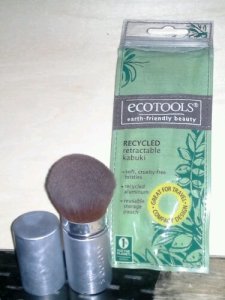
$10 Well Spent! Recycled Eco Friendly Kabuki Brush

Taklon Bristles

EcoTools Recycled Kabuki Brush from Whole Foods

 I purchased this brush on a whim from Whole Foods months ago and finally opened the package. My other Bare Mineral Brushes are years old – I knew they had to go. I don’t think it matters how well you clean those brushes, I’m convinced brush sprays and gentle cleansers cannot eliminate all bacteria from those bristles.
It was $10, I’m rounding up a penny and not including tax.

Thanks to Wikepedia I have learned that Taklon is a synthetic polyester-derived soft and smooth bristle similar to that of boar bristle. It is devoid of any common allergens because the bristles are fine and smooth as opposed to real animal hairs which are grooved and readily trap more debris with those grooved surfaces and are clearly, animal protein free. This smooth fact also allows for more easy and effective cleaning. I knew none of this when I purchased it but thought I would give Eco Friendly a try. This is all icing on the animal protein free cake.

Review: It is retractable and coverable with its cap which minimizes the elements from getting trapped in the bristles. And it is surprisingly soft. The rounded edge makes it more like a firm but fluffy medium sized (not-too-short) blush brush to spread powder (foundation) in a soft finish intstead of caking it flatly on the skin- especially in the forehead area or cheeks where it is common to have larger visible pores that just invite that cakey powder right in. I was used to using Bare Minerals or Pur Minerals flat kabuki brushes but have tossed both of them because the look is not as natural as EcoTools and the feel is not as soft.

This was $10 of animal cruelty-free, recyclable package (I am going to use it to hold my skinnier brushes) money well spent. Even with this eco-friendly version of a makeup brush, bacteria still lurks in the brushes, even after a good cleaning. I have decided to follow the three month throw away rule – that way I am not taking any chances with my skin and with my health.

Do you have any eco friendly cruelty-free brushes that you love?

On the path to acne free

ACNE HELP: Irritated by stubborn acne? Most over the counter products will irritate and dry out the skin, hindering your body’s natural repair cycle and actually cause more inflammation and breakouts. It is best to apply calming, hydrating, sensitive skin (fragrance free) ingredients to the skin to first fully hydrdate and repair the skin’s barrier.

Skincare is only a piece of the acne-free puzzle. Before booking an appointment at the nearest spa or dermatologist, do your part:

1. Drink water. And, lots of it. Begin to hydrate yourself from the inside out and flush out those extra toxins. Drink half your body’s wieght in ounces, daily.

2. Dramatically increase your fruit and vegetable intake. Especially those with vitamin A: Broccoli, spinach, apricots, and carrots. Uncooked is best, daily.

3. Begin to exercise – this allows proper nutrients to be transported throughout your body by increasing circulation on a dialy basis. Stress deprives our skin of proper nutrients and exercise delivers those nutrients.

Begin to incorporate these steps every single day to begin your inside out bodily transformation. THEN and only then, we can begin to talk skincare – the small but still important step in achieving acne-free, healthy skin.

 Here’s the d…

Image

Here’s the decades old question… bar soap or liquid soap?

I was once told that the fact that a bar is in ‘bar form’ means that it contains more harsh and drying chemicals than liquid soaps in bottles.   This is pertinent information to a medical esthetician working alongside cosmetic and general dermatologists.  More so than the fact that it may harbor more bacteria than liquids.  However, I should not have been so naive in my younger 😉 days and should have demanded proof before allowing my beliefs to be so easily swayed by a little piece of information, with no backing to such a statement.  Have you ever marveled at ALL of the harsh, synthetic, drying ingredients on the back of a liquid soap bottle?  Or, any bottle?  Or bar of soap?  I have.  Quite recently!  It’s disturbing and a rude awakening, every time.  I’m still marveling, over the fact that Dove Sensitive skin ‘beauty bar’ contains tallow, which comes from fatty acids in cattle and sheep.  Vegetable and plant oils, I’m sorry, “extracts” aren’t enough, I guess.

I’m really not surprised that my daughter’s first pediatrician ‘who had been doing this longer than I had been alive’ told me to use this sensitive skin dove bar on my baby girl who was not even eight months old at the time and who was and is severely allergic to cow protein.  No wonder she was more itchy and her eczema FLARED!  [I always questioned product ingredients and product integrity when I wasn’t supposed to worry about such things.  But, I was supposed to accept the good with the bad and be objective about that]- .  My baby’s former pediatrician is no different from, let’s call them ‘people’, I previously worked for whose over the counter skin care recommendations came from whatever sample skin care product:  body bar, anti-dandruff shampoo, sunscreen, face or body lotion…you get the idea, they had in their sample closet.  Unless you work(ed) in a doctor’s office, you don’t know that these skin care sample products are donated by drug company representatives who provide the entire staff gourmet catered lunches (and lovely paperweights) in exchange for merely two minutes of the doctor’s time-because a 2 minute briefing of their NEWLY FORMULATED, BETTER ABSORBING, MICRO-FINE INGREDIENT with PATENT-PENDING TECHNOLOGY product now gives an almost guarantee that their product will be given out to patients and recommended on the patient home care regimen handout to making the rep’s projected monthly sales goal almost more tangible; all while the patients’ skin care woes disappear.  Have I strayed off topic?  Not yet, there is a point.  And here it is.

My baby’s pediatrician had no clue what was and still is in that little dove beauty bar that HE RECOMMENDED I use on my baby girl who has/had severe food allergies to wash her skin daily and nightly! because she has such reactive skin, and it’s gentle.    It’s not as gentle as the label says!  And, the doctor hadn’t the slightest clue that he was telling me to apply an ingredient from his said product that causes the most allergic contact dermatitis from her list of food allergies.  I had no choice but to go organic for her and her poor itchy skin’s sake.

So, my first point (I have many), just because the product recommendation comes from a doctor (especially a prescription, sorry, Doc) does not mean the product will heal, help heal, or prevent a chronic skin condition.  Most common:  eczema, itching, redness, bumps, hives, flaking, tightness, burning, stinging (these are all possible categories of a sensitive skin condition).  Okay, I promise to stay on topic as the title states.  What does all of this have to do with liquid vs bar soaps?  ALL of the over the counter brands are virtually the same manufacturing company.  Huh?  Dove is made from Unilever.  Lever is made from Unilever.  Dove and Lever are made under the same manufacturing plant umbrella.  Think Dove is SO much more moisturizing due to the 1/4  moisturizing cream than the Lever Body Bar?  I scoured over the ingredients, just trying to invent a moisturizing ingredient that accounts for that 1/4  part cream, eventually my mind went…b l a n k.  I couldn’t find it, and I study ingredients.  Labels are more or less useless.  We must all learn to read the ingredient list.  Ingredients don’t lie – Labels do.  Stay with me, this is where it gets GOOD.  An article from Daily Finance confirmed from a product formulator at Proctor & Gamble (Makers of Olay, Pampers, and tons (I forget the exact number but it’s a LOT) of household products that we all love and use) actually admitted that body washes net P&G 30-50% more $$$ than bar soaps!  WOW, how very honest!  And body washes now account for more than 70% of the entire bath market, that’s some phenomenal billion dollar advertising on their part, it paid off, literally!  Additionally, a NY Times study conveyed that bar soaps do NOT harbor enough bacteria to cause sickness or ill-health, especially when rinsed off after use.  Of course  bars are cheaper to make; they are not the company’s top producer – between the two, body washes are.  P & G product formulator stated that skin-improving ingredients can be added to liquid lotions but NOT bars.  I don’t believe that.

First, a true ‘skin-improving’ ingredient can only be called a drug, that’s why there is separation between prescription drugs and the cosmetics (skin enhancing) industry, and why every single over the counter, yes, department stores, too) skin care and makeup company has to get us ‘oohed and ahhed’ over their advertising, usually falsely displayed, to get us to buy their product instead of a prescription.

Second, it’s a body WASH.  Not, a SERUM.  Body washes and skin cleansers, can only cleanse the surface of the skin.  You can apply water to dehydrated skin and immediately on the surface the skin ‘appears’ improved.  But, has the skin itself been ‘improved’?  No.  The skin is improved when the lower layers, where a cleanser does not and cannot go where those lower layers of damage are repaired.  You can use a $60 cleanser, yep!  from France until you’re so cleansed you’re…blue, and be left with nothing but dehydrated skin and lost hope.  Even the nicest cleanser has detergents in it, and surfactants.  Cleansing and foaming agents give you that stripped, clean feeling (leads to tightness and dryness if it’s too cleaning for a sensitive or dryness-prone skin type).  Where else have you heard the word detergent?  Oh, I don’t know, laundry; all similar if not the exact same cleaning ingredients in our products.

Bar soaps and liquid soaps:  They both have high concentrations of unnecessary ingredients in them (Sodium Lauryl Sulfate is incorporated into nearly 80% of all over the counter hair care and body care products, it is a known skin irritant and certain researchers label it as controversial) Too many surfactants and detergents which over time will dry out anybody’s skin- I ask, how much foam or cleaning soap does one really need?  And, what about the little skin-enhancing ingredients in a bottle of liquid wash, or that pretty ‘scent’?  The fragrance is artificially added and can irritate the skin over time and has not one ounce of skin improving quality in its little existence; and, the ‘skin enhancing!’ ingredients are negated by all of the harsh ones.  If you are to follow my opinion, I choose neither.  What a waste of even a couple of dollars.  I would rather ingredients be benefitting my skin 100%.  However, if you do not mind using what you’ve been using all of your life, go with the cheaper option, the bar because the body wash ingredients cannot even hold a bar of soap they are so lousy, no matter what the commercials and magazine ads say.  Just remove those bar suds with a loofah, sponge or wash cloth – they are known to leave residues on the skin and prevent other products such as moisturizers from appropriately absorbing into the skin.  If I have a change of heart because a mass producing bath or skin care line changes their ingredients (for the better) I will re-post, but until that day comes…


Wishing you an enlightened mind and healthy skin,


Melissa Armstrong,

Licensed Esthetician & Skincare Educator

Do you have more freckles on your chest, neck, back, arms (and face)? Time to re-evaluate those pretty lotions and sprays.

artificially fragranced, chemically infused lotions and sprays

Look familiar? Perhaps these look similar to the bottles you have on your counter or in your cabinet. These are the WORST to apply in the summertime. Why? Bath & Body is a big alcohol-adding culprit- in some cases over 50%. Alcohol is not a skin-benefitting ingredient by any means, quite the opposite. It is known as ” a photo-sensitizing ingredient “. Simply put it makes your skin sensitive to the sun. Do you have a lot of ‘freckling’ or ‘wrinkling’ on the chest, neck, and shoulders? READ THIS.

At first I was going to recommend avoiding only perfume and body sprays, but then I recalled that fragranced lotions contain nearly identical ingredients which puts them in the same sensitizing boat as those body sprays! What does sensitizing actually mean? Well,the sun is especially attracted to those spots of skin that have that alcohol ingredient sprayed on them and it will lead to further skin damage, these conditions being the most common: wrinkling, fine lines, freckling, mottling. Think of spraying your hair or your body spray while you are wearing a tank top. Today was 95 degrees outside – I pulled my hair up, sprayed my hair with my hair spray and realized in addition to my hair, I also sprayed my face, shoulders, chest, and neck. I immediately wiped off those areas with a wet wash cloth. THEN I applied SPF 30 sunscreen. I recommend you do the SAME. If I hadn’t removed the chemically-infused spray, I would have developed even (more than I already have now) splotches and freckles and tiny brown dots on my skin.

I know that I cannot tell you to avoid all of your lotions, sprays, and perfumes; and guys, your cologne. But if you will compromise with me and avoid lotions, sprays or perfumes containing alcohol in the first five to seven ingredients on your product label, (during, those hot summer days) you will be doing your skin a great service.

Even toned, un-freckled skin is associated with youthful and healthy skin. Take my advice and obtain healther, younger looking skin by, if not avoiding those ‘artificially fragranced’ lotions and sprays, at least by wiping the skin off by using a wet cloth to those sprayed areas and by following that with the application of an SPF 30 moisturizer, daily.

As a recap:

1. Avoid fragranced, alcohol infused sprays, lotions, perfumes and colognes in the summertime.

2. If the thought of the first step is prompting you to breathe repeatedly into a paper bag, be sure to wipe off the additionally sprayed areas of skin using a wet wash cloth after using your body spray or hair spray. Still tempted to apply that lotion? I can’t help you.

3. Cover exposed areas of the skin when applying hair spray.

4. Apply SPF 30 to all exposed areas of skin prior to going outside (to avoid further skin damage from UV rays). See my SPF article for more information on this topic.

-Wishing you healthy skin,

Melissa Armstrong,
Licensed Esthetician & Skincare Educator

SPF. Time for a refresher course. Part 1 of 3.


Sunscreens come in all different shapes and sizes, and SPF’s! Waterproof, very waterproof, very very very waterproof (I’m not kidding, this is actually on a product label; baby sunscreen, children’s sunscreen, bug repellant sunscreen, SPF 8 to SPF 105+!!! My exclamations are purely sarcastic here; as are most of my blurbs about absurdly overstated hugely false skincare claims, yes this refers to all of my articles, and I give you exhibit F, SPF 100+. This is about as bogus as Loreal’s commercial for NEW sulfate free shampoo and conditioner. There is no possible way to test that an SPF 70 is actually effective for the duration of time that it claims on the bottle. Why? Because it will either melt or sweat off, or simply break down!

Let’s use myself as an example. SPF stands for Sun Protection Factor, or, it used to. This should mean the amount of minutes I can remain in the sun before I start to become noticeably burnt (pink/red) due to excessive exposure to UVB (burning) rays. According to a Neutrogena SPF 70+ Sunscreen, this would mean I am protected at least 70 times passed my 60 minute burn factor (the amount of time, approximately, before my skin will start to burn if I’m baking in the sun without any sunscreen protection). So, if I were to trust this SPF 70, I would be protected for approximately 4,200 minutes after I apply my sunscreen! Or in standard terms, 70 hours!! Wow, that is some GOOD sunscreen. I just watched Jennifer Garner’s pretty face on the latest summer campaign for Neutrogena SPF 100!!! They were sued for this in 2010 and have not changed their course one bit! I repeat, if I were to trust that, I would be blistered, peeling, and in severe, medically treated agony. It has happened to me numerous times in my unaware childhood days.

So here is the sunscreen knowledge that will hopefully save you from being in agony during your next outing or vacation due to mislabeling.

1. True, beneficial research stops at SPF 50 (some Doctors say SPF 30). I recommend if you have not had precancers or any cancers removed or diagnosed, and do not burn easily, you are fine with a daily spf 30 sunscreen. If you have photo-aged skin or sensitive skin or have had several burns in your life, your skin is more sensitive and prone to burning or aging. You MUST MUST reapply that sunscreen every 2 hours for you to maintain the proper level of protection.

2. If you have skin like mine, burns easily, is sensitive and is beginning to show aging signs, I recommend you use an SPF 50, daily. No higher, because it does not protectively exist in the real world (maybe in the make-believe SPF world, but we are going to come off of that naive SPF cloud and plant our feet firmly on skin care aisle floor). And, for you on those long outside days you also need to reapply about every 90 minutes to keep from burning and to keep those harmful rays from doing damage to the lower layers.

HYPE WORDS: Water-proof, baby, child, water-resistant, very very very water-resistant (what??), SPF 70+, SPF 100+, sweat proof, sport – all falsely advertised. This way, when you’re out running, you can apply a sport sunscreen. And when you’re just running errands, you can apply a daily radiance spf 15 moisturizer for the face, and when you’re swimming, you can apply a water-resistant one. (That’s big bucks for the sunscreen industry).

Bottom line, all sunscreens wear off in about 90 minutes to two hours, and there is no magic hocus-pocus, for decades (think about all the research and clinical studies, ooh, ahh – B.S.) that will make them perform any differently, or magically. The maximum amount of SPF that has some research behind it’s most likely false label is SPF 50, so spare yourself the couple extra dollars by leaving the SPF60+++’s on the shelf. More to come about SPF ingredients and chemical vs physical ingredients.

Wishing you healthy skin,

Melissa